
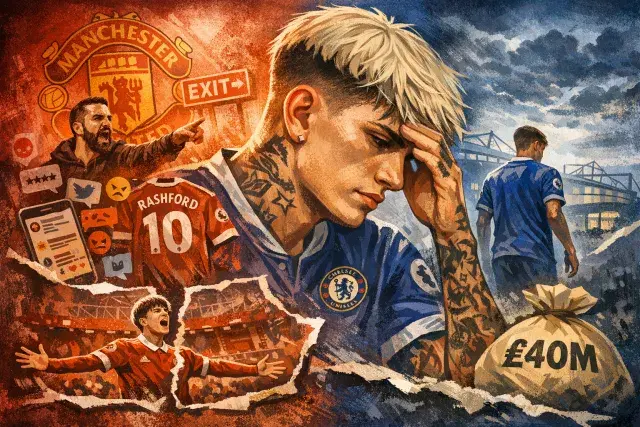
Alejandro Garnacho has acknowledged, for the first time publicly, that his own conduct accelerated the breakdown that ended his time at Manchester United. The 21-year-old Argentine winger, who completed a £40 million move to Chelsea last summer, spoke with unusual candour about a final chapter at Old Trafford that was defined as much by his own decisions as by the club's. His admission is a rare moment of self-reckoning from a young professional whose public behaviour during that period drew widespread criticism.
A Deterioration He Helped Create
The rupture between Garnacho and Manchester United did not happen overnight. His relationship with manager Ruben Amorim deteriorated across the second half of last season, culminating in reduced appearances, reported disciplinary concerns, and a series of actions — his own and those of people close to him — that made a resolution between the two parties increasingly unlikely.
Speaking in a Premier League interview, Garnacho was direct about his own share of responsibility. "In my mind, maybe it is also on me, I started to do some bad things," he said. "But yes, it was just this moment in life and sometimes you have to make decisions." He described a mental state that many young professionals in high-pressure environments will recognise: a refusal to accept a reduced role, and the damaging choices that followed from that refusal. At 20, with several years of high-visibility exposure already behind him, his response to being rotated was to externalise frustration rather than adapt.
The conduct that compounded his position included his social media activity during the period of exclusion, inflammatory online posts from a family member, and a widely circulated image of him wearing the Aston Villa shirt of Marcus Rashford — another United figure who had departed under a cloud. Each of those episodes, while perhaps minor in isolation, reinforced the club's view that the relationship had run its course.
Loyalty and Loss, Held in Parallel
What distinguishes Garnacho's remarks from a standard diplomatic distancing is his apparent sincerity about what United meant to him. "I loved that club," he said. "They gave me the confidence from the start, from Spain, to bring me to the academy, then they bring me to the first team." He described four or five years of what he called "amazing love" — from supporters, from the environment — and framed his departure not as a betrayal but as an inevitability born of circumstance. "Sometimes you have to change for the good of your life or the next steps," he added. "I only have good memories of Man Utd."
That tension — between genuine affection for a former employer and behaviour that made staying impossible — is psychologically coherent, even if it is uncomfortable to hold in both hands at once. Adolescence extending into early adulthood is a recognised developmental period during which impulse regulation, long-term reasoning, and the management of professional identity are still forming. That framing does not excuse poor conduct, but it does contextualise it. Garnacho was, by his own account, a young man reacting badly to a professional reality he was not yet equipped to accept.
A Fresh Start That Has Not Yet Delivered
Chelsea's decision to invest £40 million in a 21-year-old with evident ability but documented instability was a calculated risk. The returns so far have been modest. Garnacho has found consistent performance difficult to sustain under Liam Rosenior, who took over from Enzo Maresca in January. A solitary Premier League goal this season has not justified the fee or the expectations that accompanied his arrival, and his minutes on the pitch have reflected that output.
The broader context at Chelsea has not helped. The club's exit from the Champions League and a poor run of domestic results have created an unsettled environment — not an obvious remedy for a young professional still carrying the psychological weight of his previous departure. When the collective is struggling, individual performers who need confidence and continuity are rarely the first to benefit.
Reports have now emerged linking Garnacho with a loan move to River Plate, his Argentine homeland connection offering a potential route back to consistent exposure and form. That River Plate's Eduardo Coudet is said to have made personal contact with the player suggests the interest is genuine. Whether Chelsea would sanction such a move — given the length of his contract, which runs to 2032 — remains an open question. But the fact that the conversation is apparently happening at all illustrates how quickly fortunes can shift for a young professional operating at the highest level.
What This Reflects About Young Professionals Under Pressure
Garnacho's trajectory over the past eighteen months offers a case study in how quickly a public professional reputation can fragment when personal conduct and performance decline in tandem. His willingness to accept partial responsibility — without deflecting entirely onto Amorim or the club — suggests a degree of maturity that was notably absent during the period he is describing. That growth may yet be the most important development in this story.
The question for the months ahead is whether that self-awareness translates into the sustained effort and discipline that his ability has always promised. A contract until 2032 means Chelsea retain significant leverage over his future, regardless of where he is performing. But at 21, with genuine quality not in serious dispute, the window for a substantive rehabilitation remains wide open — provided the decisions he makes from here are better than the ones he has now had the honesty to regret.